We had a great time at the 2012 Akron ADDY Awards on Friday night — big thanks to AAF Akron for putting on the event. We are super proud to report that we won multiple awards in various categories, including 5 golds, 2 silvers, a Best Use of Printing award, Judge’s Choice and Best of Show for the following works:
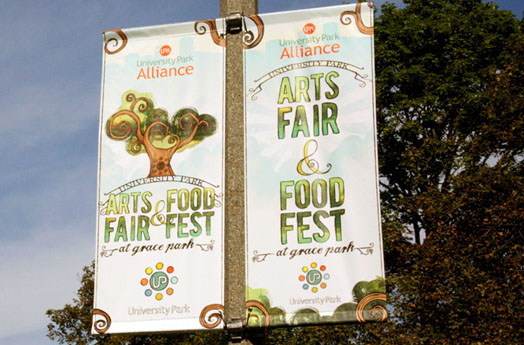
Best of Show and a gold award for the University Park Arts Fair and Food Fest Campaign
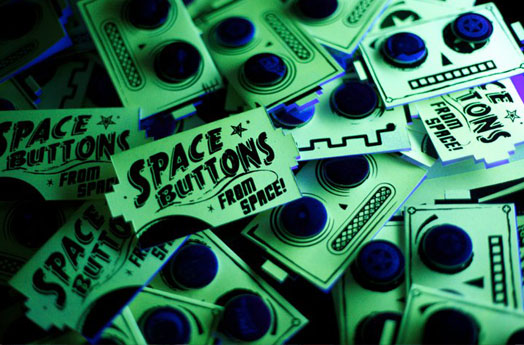
Judge’s Choice and a gold award for the 427 Design Open House V Campaign
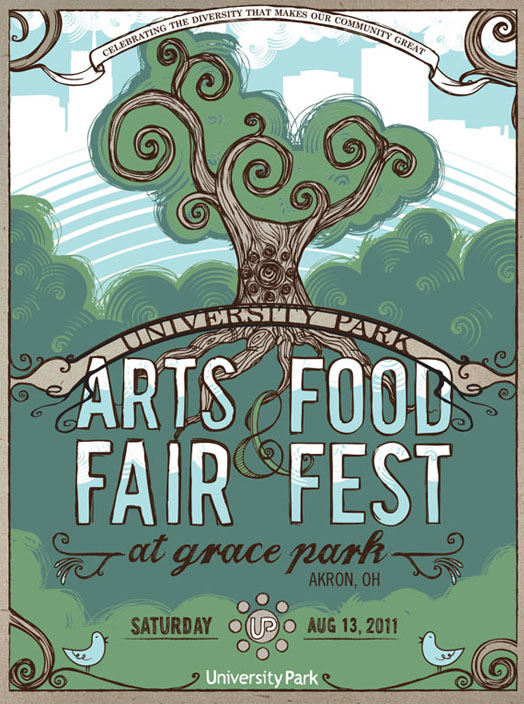
Best Use of Printing and a gold award for the University Park Arts Fair and Food Fest Poster
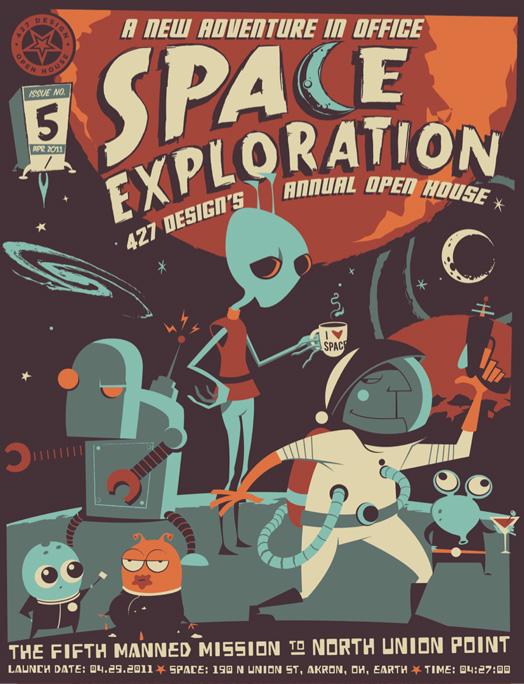
Gold award for the 427 Design Open House V Poster
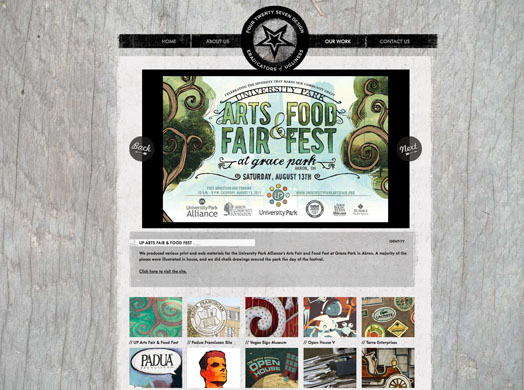
Gold award for the 427 Design Web Site (hint: you’re on it right now)
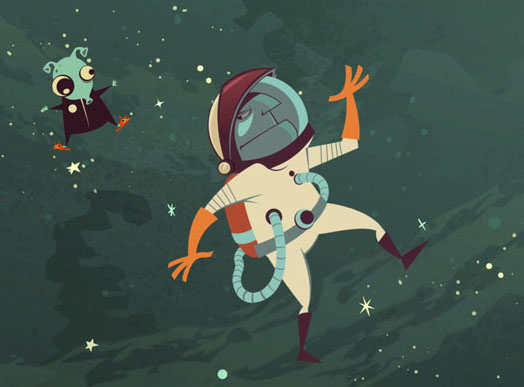
Silver award for the 427 Design Open House V Animation invite
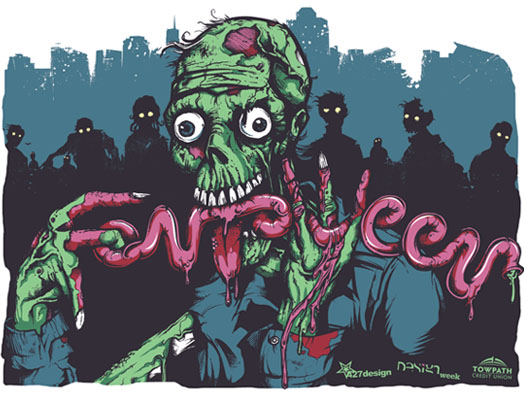
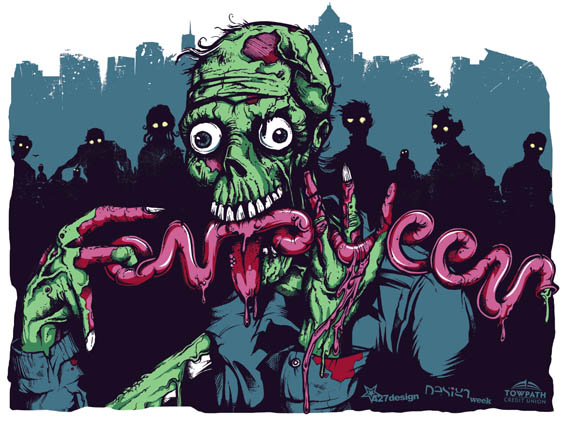
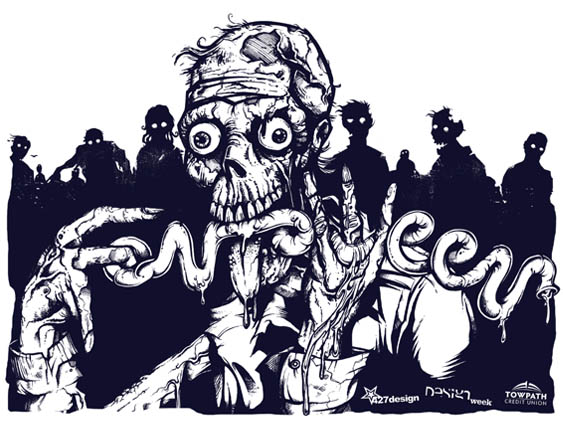
Silver award for the Fontoween Poster Illustration
Congratulations to all of the other winners including TRIAD/Next Level for their impressive work and resulting haul (8 golds plus a Judge’s Choice). Now that the celebrations have subsided, we’re excited to get back to work on potential entries for next year, including an update of this (award-winning) site you’re currently on and materials for our 6th Annual Open House (on 4/27 this year).
Thanks again to AAF Akron and everyone who helped make this year’s ceremony such a success!
According to the musical, Rent, there are numerous ways to measure a year. You can add up the daylights and sunsets (365 of each expected this year, respectively) or even the midnights (the same). You can count the cups of coffee (let’s say, conservatively, two cups a day x 4 habitual coffee drinkers x 52 weeks, minus weekends + an extreme increase halfway through the year when Sam mysteriously discovered coffee = math is hard), or maybe you can’t, really.
You can also count the minutes, but thanks to Jonathon Larson, you don’t have to — in one year there are five hundred twenty-five thousand, six hundred of them to be exact. Here’s what we did with ours:
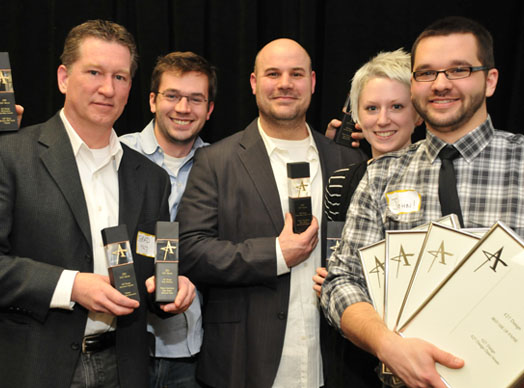
We won awards:
In February we won 10 local Addy Awards — 5 gold, 4 silver and the Best Use of Paper and in April, we won 3 additional District Five Addy Awards — 1 gold and 2 silver.
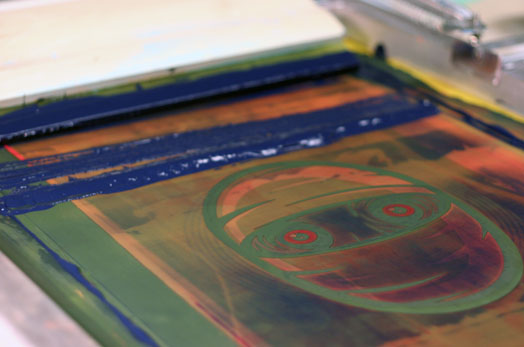
We printed all of the things:
We turned a portion of our photo studio into a silk-screening workshop — officially christened, The Print Lab. We’ve since printed posters, t-shirts and basically anything that will sit still long enough under a screen.
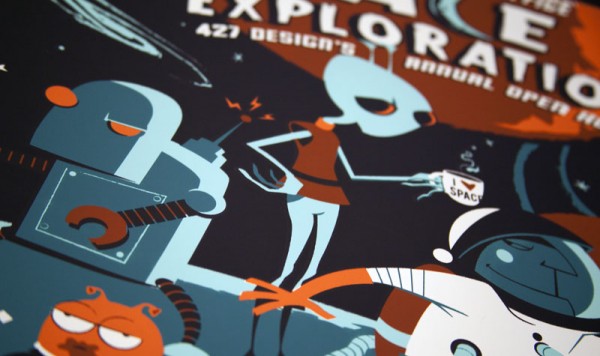
We opened our house:
In April, we celebrated the beginning of our fifth year with our biggest and best open house to date. We had glow-in-the-dark button packs, screen-printed posters and we each built our own robots. Guests dined on moon cheese, astronaut ice cream and posed for a photo booth with custom-made ray guns. Dare we say, the space-themed bash was… out-of-this-world.
We made this site:
In case you didn’t notice, this beautiful (and functional!) site you’re on — it launched in May of this year. We hope you enjoy the weekly blog posts, deep thoughts and portfolio updates, all of which will continue into the new year (and hopefully many years after that).
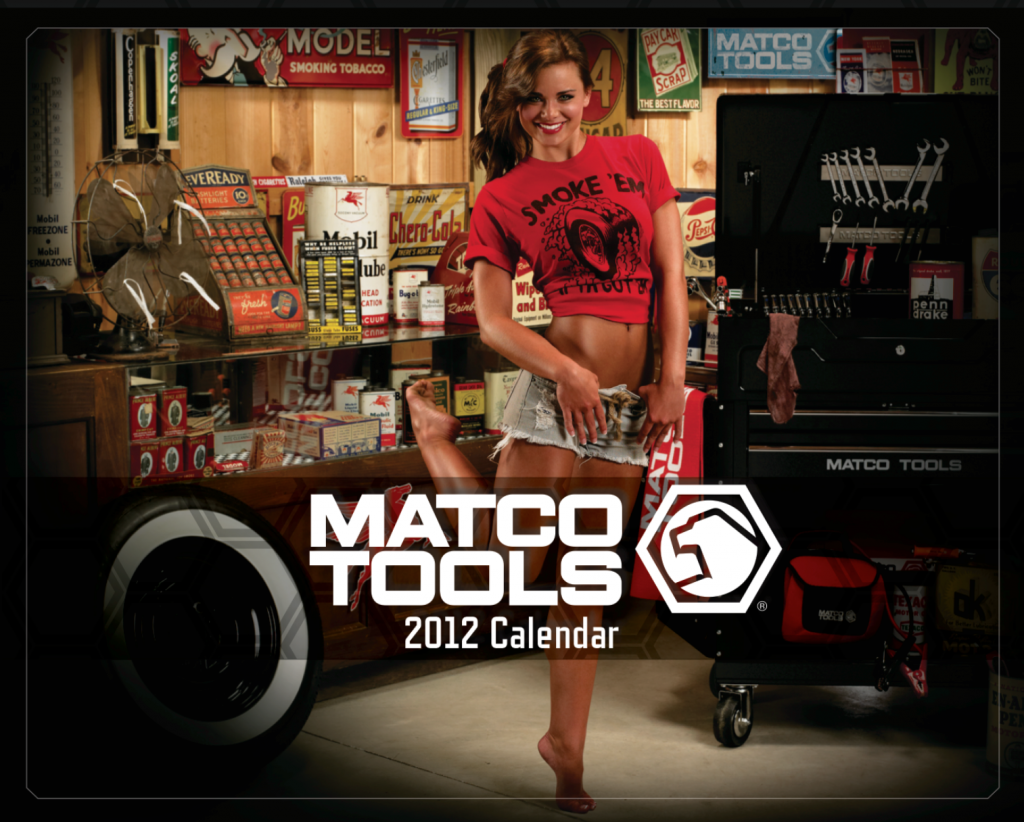
We made a calendar:
We spent the majority of our summer working with Studio Martone and the good folks at Matco Tools on the 2012 Matco Tools Calendar, a huge project that we’re still (nearly six months later) super excited about. We scouted mulitple locations and ended up shooting at six great ones — DSR Racing in Indiana; Cain BMW in Canton, OH; a replica Mobil Gas Station in Waynesburg, OH; Lucas Oil Raceway in Indiana; MAPS Air Museum in North Canton, OH and a picturesque farm in Magnolia, OH.
Look for the final art to be added soon to our print and video sections.
We bought a building:
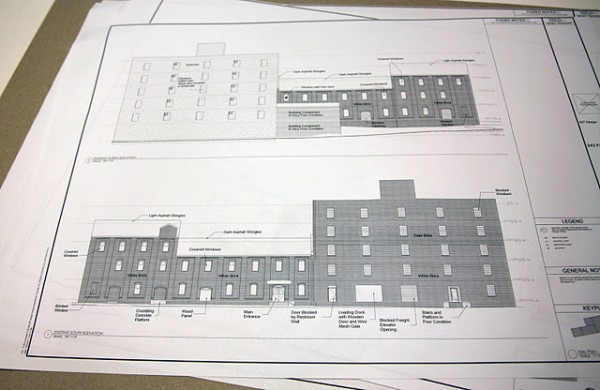
Somehow, in the midst of the Matco madness, we managed to buy a building. A 58,000 sq foot, cereal factory from the 1890s at 243 Furnace Street. You can read all about the ongoing project here, here and here.
We hired some people:
Over the course of the year, we’ve had two interns (one of which we hired part-time — lookin’ at you, Manders) and hired Sam Karlo and Jameson Campbell on as full-time employees. And we haven’t regretted at least two of these decisions.
We worked hard for the money:
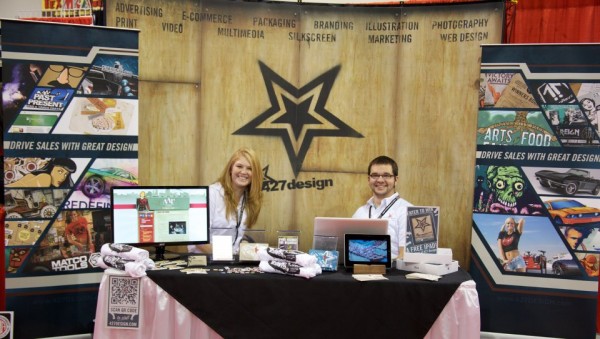
Justin, Amanda and John manned (and wo-manned) the 427 booth at the SEMA show in Vegas this November. They claim that they worked harder than those of us stuck back here in frigid Ohio, but we remain unsympathetic and unconvinced.
And then, we bowled:
To celebrate all 525,600 minutes of our work this year, we had our Christmas party at Stonehenge Family Fun Center last week, where our talents on the lanes ranged from non-existent (ahem, Joe) to inconsistent (hi, Jameson) to why-are-you-wasting-your-talents-working-for-us amazing (Brad “Bad” Hain and Sam “The Hurricane” Karlo). We only managed to get photos of two out of the three ‘teams’, because the third team had already taken their talents to the Ski Ball machines.
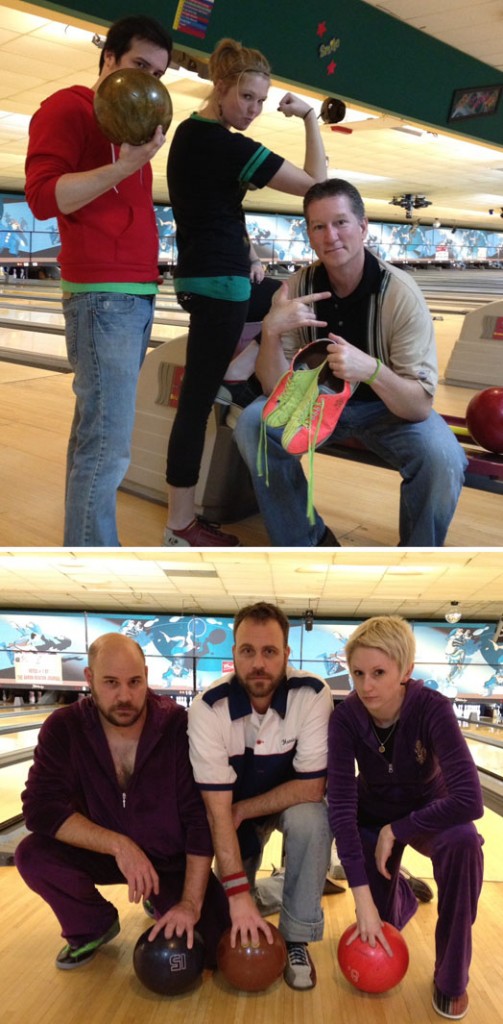
Is there a more fitting tribute to a year of great work, hard work and fun work than purple velour jogging suits, two personalized bowling shirts and a little friendly rivalry? We didn’t think so.
If you’ve ever changed the handles on your cabinets, or moved a wall clock, you know that we are creatures of habit. We gravitate towards the right (unless you’re that one, slow a-hole blocking rush-hour stair traffic) and buy our beverages based solely on the color of the can.
We’d like to think that we’re incredibly self-aware, able to make informed choices and possess open minds, but if the recent Coca Cola s-can-dal has taught us anything, it’s that we’re anything but. Basically, as an attempt to call attention to a partnership with the World Wildlife Fund, the powers-that-be at Coke released a special holiday version of their classic red can — something they do every year — but this one was, wait for it … white. GASP!
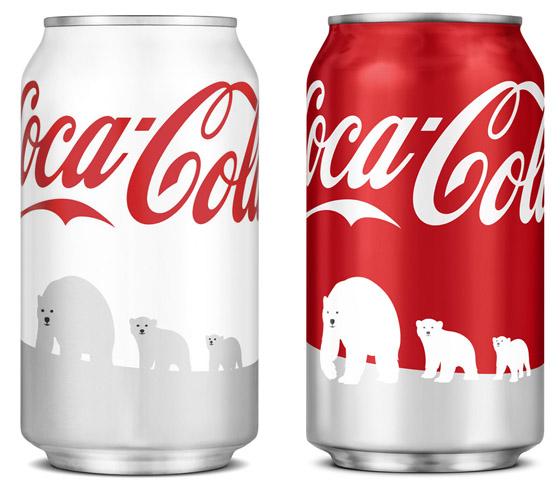
Mayhem ensued, with diabetics unknowingly guzzling the classic (read: sugar-filled) formula — duped as they were by the white can. “It was too similar to the Diet version!” they exclaimed. “It tasted differently“, others insisted. Never mind that the can clearly shows the “Coca-Cola” logo — much different, aesthetically from the Diet Coke branding — and that the iconic script occupies nearly a third of the can. Also, ignore the fact that the outside packaging remained red. America had had enough and demanded that the hoighty-toighty design-conscious snobs stop messing around with their beloved can.
So, they did. Coke is pulling their “bastardized” cans from shelves and replacing them with different, more consumer-friendly (red) designs — a plan they claim was always in the works (how convenient).
Aside from highlighting the incredibly finicky nature of the American consumer, this recent s-can-dal only reinforces what most designers already know: change is a difficult sell. No matter how much of an improvement, or how much more aesthetically pleasing a design may be, re-branding a product (or company, or person) can be an enormously difficult and touchy undertaking.
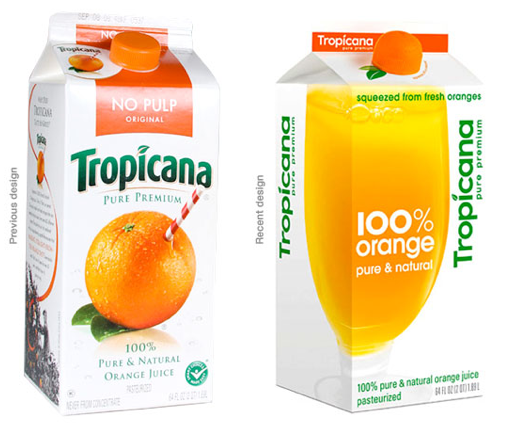 Aunt Mae’s corner cupcake shop is one thing. Huge, well-loved and well-known brands face the ire and criticism of the whole world, or at least it can seem like it (especially with the advent of that every-man’s soapbox, Twitter). Just ask the marketing departments at Tropicana or the Gap — both companies rolled out “drastic” (and I’m sure, very expensive) redesigns of their beloved brands this year, only to say out with the new, (back) in with the old, as a response to the outcries each respective design received.
People don’t like change, or at least most people don’t — whether they’re aware of it or not. Just because something is new, however, does not mean it is inherently evil — although I could argue that there have been plenty of re-brands that should have been scrapped, or at least immediately re-worked (I’m looking at you, Pepsi).
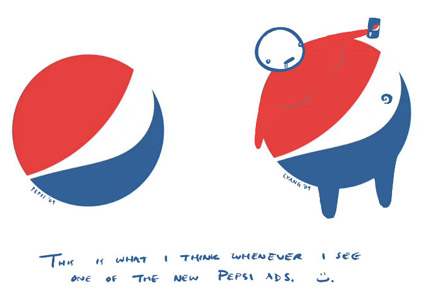
As designers, we generally have pretty amazing jobs. We’re not working in a coal mine, or operating on hearts — at the same time, our profession is legitimate and some times (if we’re lucky) even influential. We have to be thoughtful and respectful with our ideas, whether they be for Aunt Mae or an industry titan like Coke.
And then, we have to stand behind our choices as professionals, or be prepared to crumble and suffer the often-times, very public (and expensive) indignity of a “just kidding” (Qwikster, anyone?).
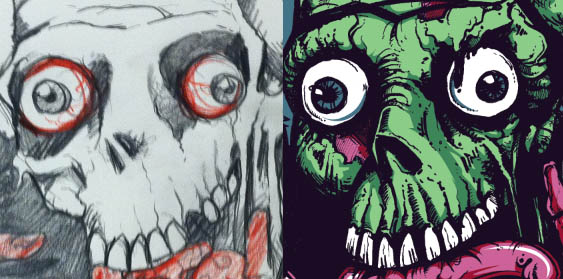
We recently worked in conjunction with the University of Akron to create art for a Design Week, “Fontoween” poster. The five-color poster was printed at our studio by a group of design students, who, over the course of three days, learned the ins and outs of screen printing and hopefully had a good time in the process. Apparently learning can be fun, especially when it involves glow-in-the-dark ink, one particularly gnarly zombie and a whole lot of illustrated intestines.
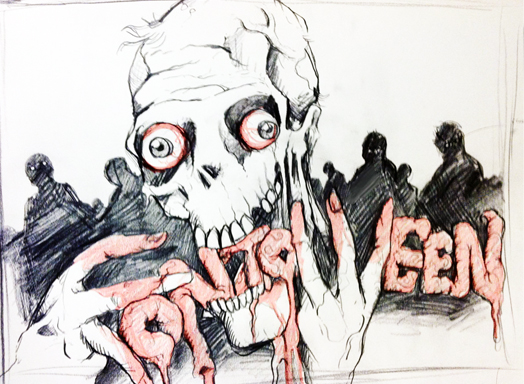
Our illustrator, Joe, walks us through his illustration process and offers us a glimpse of what goes on every day inside those delicious, pink bwains of his.
Step 1:
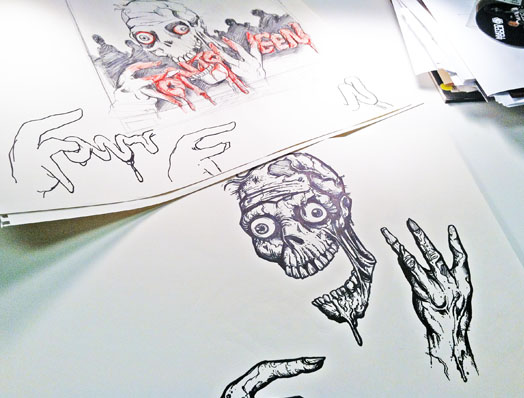
I start with a basic concept and pull from various sources of inspiration and reference. For the zombie pose, I photographed myself gnawing on my TV remote, which I will not show due to the unflattering nature of the photo. After a brainstorming session, I quickly sketched a rough concept of what I imagined for the poster. This original concept served as my blueprint for the poster building process.
Step 2:
Next, I grabbed a set of Micron pens and a fine point Sharpie and started to draw the zombie’s head. A majority of people might start with pencil and work up to markers — committing to the artwork is a big step —but I’ve always been comfortable skipping pencil all together.
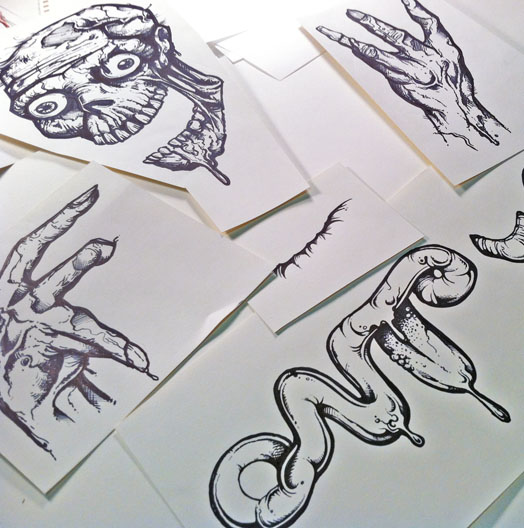
Each body part was drawn individually (and on separate sheets of paper), so I would have more control of the final art as it was scanned into the computer. After the head was done, I worked my way to his hands, neck and body — continuing to reference the original sketch as well as shots of my own hands.
Step 3:
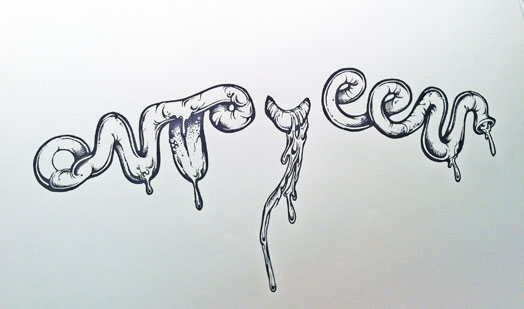
The smooth, shiny intestine-like ‘Fontoween’ had to have a different feel than his rough, sketchy skin. Figuring out exactly how the word would work was one of my favorite parts of this project — it’s not often that my creative challenge for the day includes illustrating words out of a string of innards.
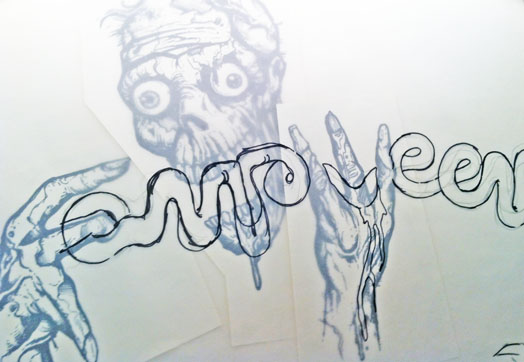
Using a sheet of vellum, I sketched the letters over the drawings of the zombie’s body, working it in through his hands and mouth. It was very important to me that I incorporated his hands, which eventually were utilized to form the ‘F’ and the ‘W’. Working with the twists, turns, and loops of the intestines, I created the other letter shapes.
Step 4:
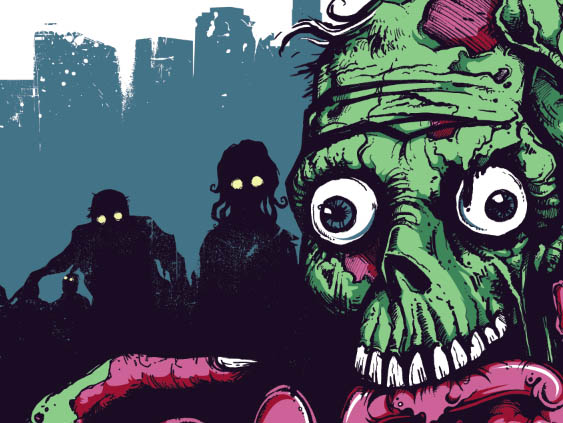
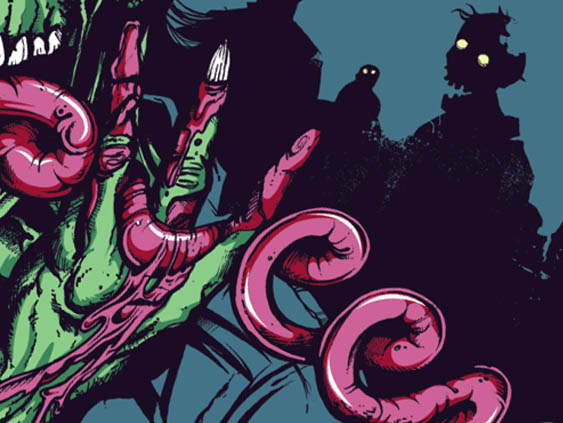
After all of the illustrations were done, I scanned the artwork at 300 dpi and adjusted the levels for maximum contrast. I was left with a black outline of all of the artwork; using the pen tool, I blocked in the shapes and shadows and started to add different color layers to bring the walking dead to life.
Step 5:
Then, once all of the colors were done and trapping was accounted for, I went in with Photoshop brushes to give the artwork a slightly distressed look.
Finally, as the finishing touch, I put a bird on it.